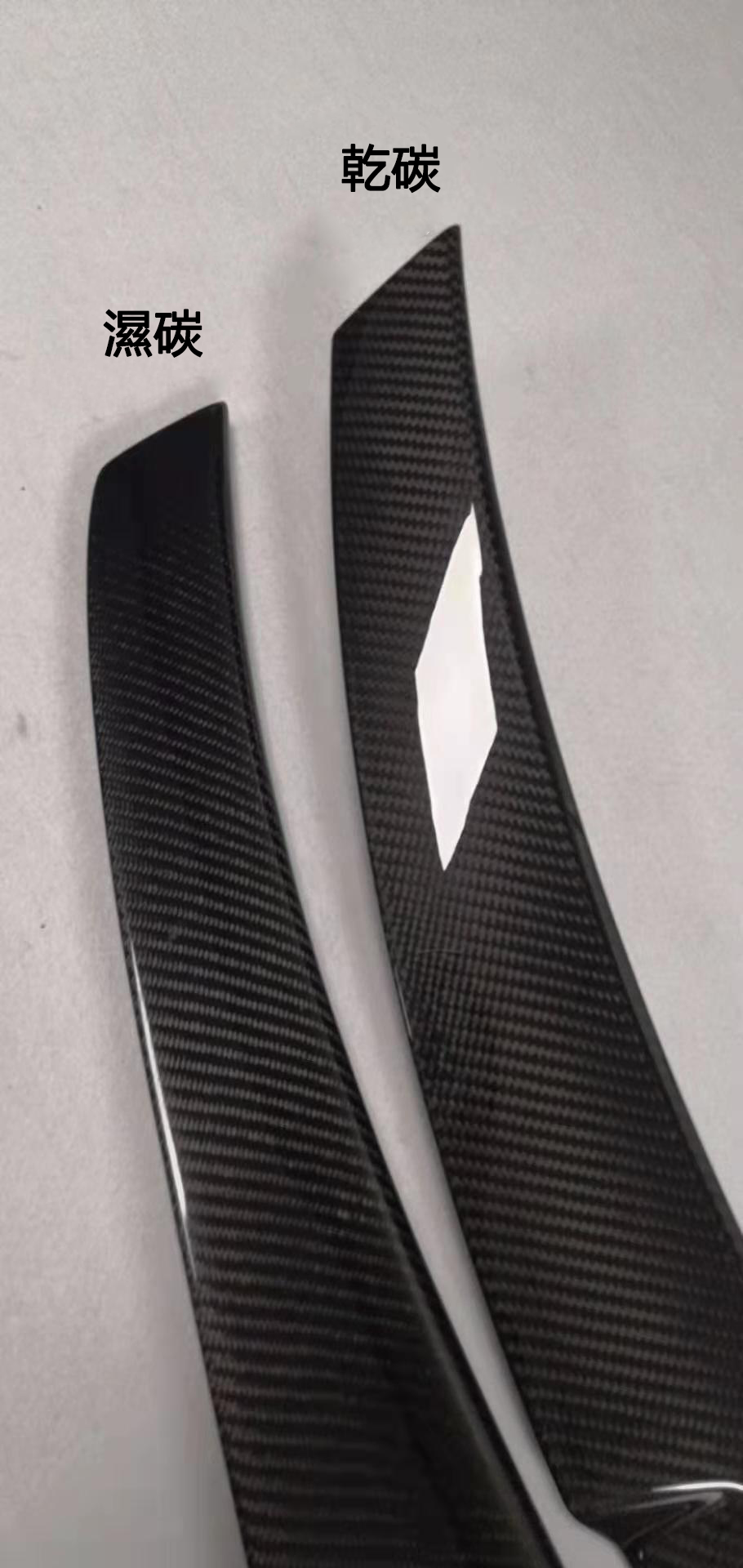
Dry Carbon vs. Wet Carbon – What's the Difference?
In the world of carbon fiber manufacturing, the terms dry carbon and wet carbon refer to two distinct production processes. The difference lies in the way the carbon fiber composite is formed, affecting everything from appearance and strength to cost and durability.
Wet Carbon Fiber
Wet carbon, also known as the wet lay-up method, involves manually layering carbon fiber fabric over a basic mold made of resin or fiberglass (FRP). The resin is applied during the lay-up process by hand.
Advantages:
Lower production cost
Faster and simpler manufacturing process
Ideal for cosmetic applications
Drawbacks:
Poor heat resistance
Susceptible to bubbles, fabric distortion, and surface yellowing
Less structural rigidity and precision
Lower durability and a tendency to crack over time
Wet carbon is often used in entry-level aftermarket parts where aesthetics are prioritized over performance.
Dry Carbon Fiber
Dry carbon refers to components produced using the vacuum bag and autoclave molding process. Pre-impregnated carbon fiber sheets (prepregs) are layered into a mold according to design specifications, then sealed in a vacuum bag and placed inside an autoclave.
Under controlled heat and pressure, the carbon fiber is cured uniformly, resulting in components with exceptional strength, surface quality, and dimensional accuracy — even for complex or large shapes.
Advantages:
Superior rigidity and lightweight performance
High precision and fitment accuracy
Scratch-resistant and long-lasting surface finish
Excellent resistance to heat and structural stress
Drawbacks:
High production cost
Longer manufacturing time
Less suitable for mass production
Dry carbon is the material of choice in motorsports, aerospace, and high-end automotive applications, where performance and durability are paramount.